Last updated: · 6 min read
From Characters to Sentences: A Parent's Guide to 造句 Practice
Sentence building (造句) is the step where recognised characters become usable language, and it only works once the child recognises the words and understands the two-character 词语 they form. The best home practice is oral first: say a sentence about the child's own day using the target word, then write it. DuoDuo Kidz Academy follows the sequence 认字 → 词语 → 造句 and never skips a step, because every later writing skill depends on it.
The progression: 认字 → 词语 → 造句
Chinese is learned in layers. First the child recognises single characters (认字). Then those characters combine into words (词语): 学 and 校 become 学校. Only then can the child build a sentence (造句): 我今天去学校。Each layer depends on the one below.
DuoDuo Kidz Academy's full Chinese path is 认字 → 词语 → 造句 → 阅读理解 → 段落 → 作文, and 造句 sits at the centre. It is the first place the child produces language rather than receiving it, and it is where word knowledge becomes writing ability.
Why 造句 homework goes wrong
Most 造句 problems come from a missing lower step. A child asked to make a sentence with 高兴 who does not securely recognise 高 and 兴, or who has never met 高兴 in a story, has nothing to build with. The result is a copied sentence from the textbook or a sentence that uses the word wrongly.
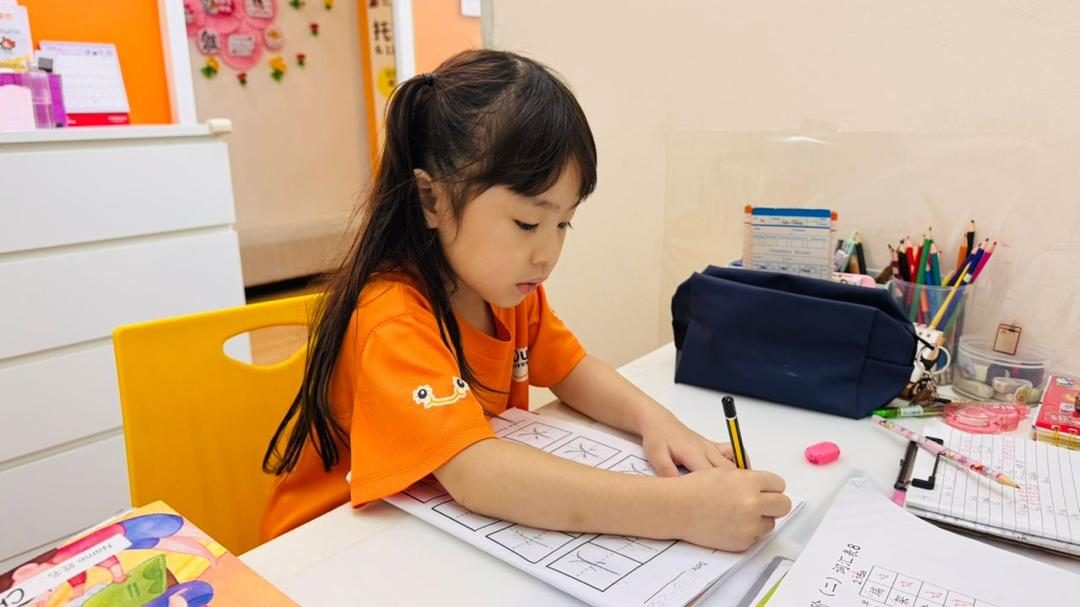
The second problem is starting with the pen. Writing a sentence involves handwriting, stroke order, punctuation and grammar at once. A child who has to think about all of that will produce the shortest possible sentence: 我很高兴。 True, but not learning.
Practise it orally first
Sentence building is a speaking skill before it is a writing skill. When the homework word arrives, talk before writing.
- Ask: “When were you 高兴 today?” and let the child answer in a full sentence.
- Ask a second question to extend it: “Why?” or “Who was with you?”
- Say the finished sentence together once, then let the child write it.
- Accept a sentence about the child's real life over a “correct” textbook sentence every time.
Guide with questions, not with answers
The temptation is to give the child a sentence to copy. It gets the homework done and teaches nothing. DuoDuo teachers guide with questions and never give the answer directly, and parents can do the same: “What does 高兴 mean? When do you feel it? Who else? Can you say that in one sentence?”
If the child is stuck after three questions, offer two sentence starters and let them choose and finish one. The child still does the building.
From single sentences to longer ones
Once a child can make a simple sentence, stretch it with connectors: 因为...所以, 虽然...但是, 先...然后. Ask for one extra detail each week: time, place, feeling, reason. A Primary 2 child who can produce “昨天下午,我在公园和妹妹放风筝,风很大,我们很高兴。” is already writing a paragraph in miniature.
Keep a sentence notebook. Reading back last month's sentences shows the child their own progress, in the same way DuoDuo's personal progress chart shows the growing word count.
Where DuoDuo fits in
In DuoDuo Kidz Academy's 1-to-1 lessons, sentence building starts the same week a new word is learned, orally first, and the teacher tracks which words the child can use, not just recognise. If your child's 造句 is a nightly struggle, a free 60-minute 1-to-1 lesson with no payment will show you which layer is missing. WhatsApp 011-2828 8676 to book.
FAQ
My child writes very short sentences. How do I get longer ones?
Ask one extending question per sentence: when, where, why or with whom. Add the answer to the sentence orally, then write the longer version.
Is it acceptable to write 造句 with pinyin for characters the child cannot write?
Yes, at Primary 1 and 2. The purpose of 造句 is sentence building, not handwriting. Replace the pinyin with characters as they are learned.
Does DuoDuo have a 造句 class?
No standalone class. Sentence building is part of every 1-to-1 Chinese lesson from the moment a child has enough recognised words, because it must be built on that base.
Give your child the most precious gift: the ability to learn on their own.
Book a free 60-minute 1-to-1 trial class in a single language subject. You'll see your child's true starting point — and exactly how we'll move forward. No payment, no obligation.