
Last updated: · 5 min read
English Phonics vs Memorising Sight Words: Which Should Come First?
Phonics should come first. A child who knows letter sounds and can blend c-a-t into cat can read thousands of regular English words, while a child who memorises sight words can only read the words they memorised. Sight words still matter for the small set of very common irregular words such as “the”, “said” and “was”, so they are added alongside phonics, not instead of it. DuoDuo Kidz Academy follows this order: letter sounds, phonics, vocabulary, reading.
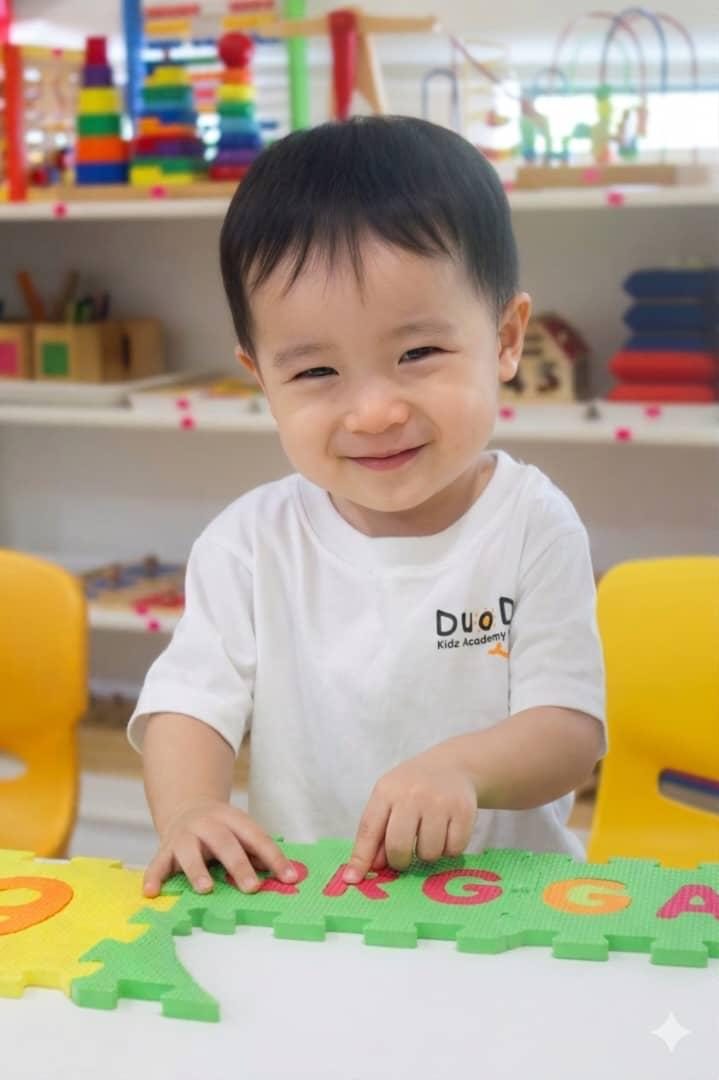
What phonics and sight words actually mean
Phonics teaches the sounds that letters and letter groups make, then teaches the child to blend those sounds into words. It is a decoding skill: the child can read a word they have never seen.
Sight words are very common words that children are taught to recognise instantly as a whole. Some are irregular and cannot be sounded out easily (the, was, said), and some are regular but so frequent that instant recognition speeds up reading (and, it, in).
Why phonics must come first
English has many irregular words, but the majority of words a Primary 1 or 2 child meets are decodable. A child with phonics can attack any new word; a child without phonics is stuck the moment a word is not on the memorised list.
For children from Chinese-speaking homes this matters even more. Mandarin is learned by recognising characters as whole shapes, so many SJK(C) children naturally try to memorise English words as pictures too. It works for a while, then fails around Primary 2 when the number of words explodes.
Memorising also gives no spelling ability. A child who decodes “ship” as sh-i-p can also spell it; a child who memorised its shape often writes “sihp” or “shpi”.
Where sight words fit
Sight words are useful once a child can already blend simple three-letter words. Introduce a few at a time, focus on the irregular ones, and always show the child which part of the word is regular so they still use their phonics.
- Start with a handful: the, a, I, is, was, said, you, they.
- Point out the regular parts: in “said”, s and d are normal; only “ai” is tricky.
- Practise in sentences, not on flashcards alone: “The cat sat.”
- Add only when the previous set is automatic.
Signs your child has been memorising instead of decoding
Many parents only discover the problem when reading gets harder. These signs show up early if you know what to look for.
- Reads familiar books fluently but cannot read a new word of the same difficulty.
- Guesses from the first letter or the picture (“horse” for “house”).
- Spelling is far worse than reading.
- Says “I don't know this word” instead of trying to sound it out.
How DuoDuo Kidz Academy teaches English reading
At DuoDuo Kidz Academy, English follows a fixed path: letter sounds, then phonics, then vocabulary, then reading. Sight words are introduced within the phonics stage for the words that cannot be sounded out, never as a replacement for decoding.
Every lesson is 1-to-1. Teachers guide with questions such as “what sound does this letter make?” and never simply tell the child the word, so decoding becomes a habit. Each child has a personal progress chart that shows which sounds and blends are mastered.
Not sure whether your child is decoding or memorising? WhatsApp 011-2828 8676 to book a free 60-minute 1-to-1 English trial lesson at any of our six branches, and we will show you.
FAQ
My child's kindergarten only taught sight words. Do we need to start over?
Not entirely. The sight words your child knows are still useful. Add letter sounds and blending now, and reading will speed up as the two skills combine.
At what age can phonics start?
Letter sounds can begin at age 4 through play, and simple blending usually follows at 5 or 6. DuoDuo's 1-to-1 programme takes children from age 4.
Give your child the most precious gift: the ability to learn on their own.
Book a free 60-minute 1-to-1 trial class in a single language subject. You'll see your child's true starting point — and exactly how we'll move forward. No payment, no obligation.