
Last updated: · 5 min read
How to Build a 10-Minute Daily Chinese Reading Habit That Lasts
A lasting reading habit needs a fixed time, books at the right level, and a parent sitting nearby for the first month. Ten minutes a day is enough because habits are built on consistency, not duration. DuoDuo Kidz Academy sees the difference clearly: children who read ten minutes daily gain recognised words two to three times faster than children who only do worksheets.
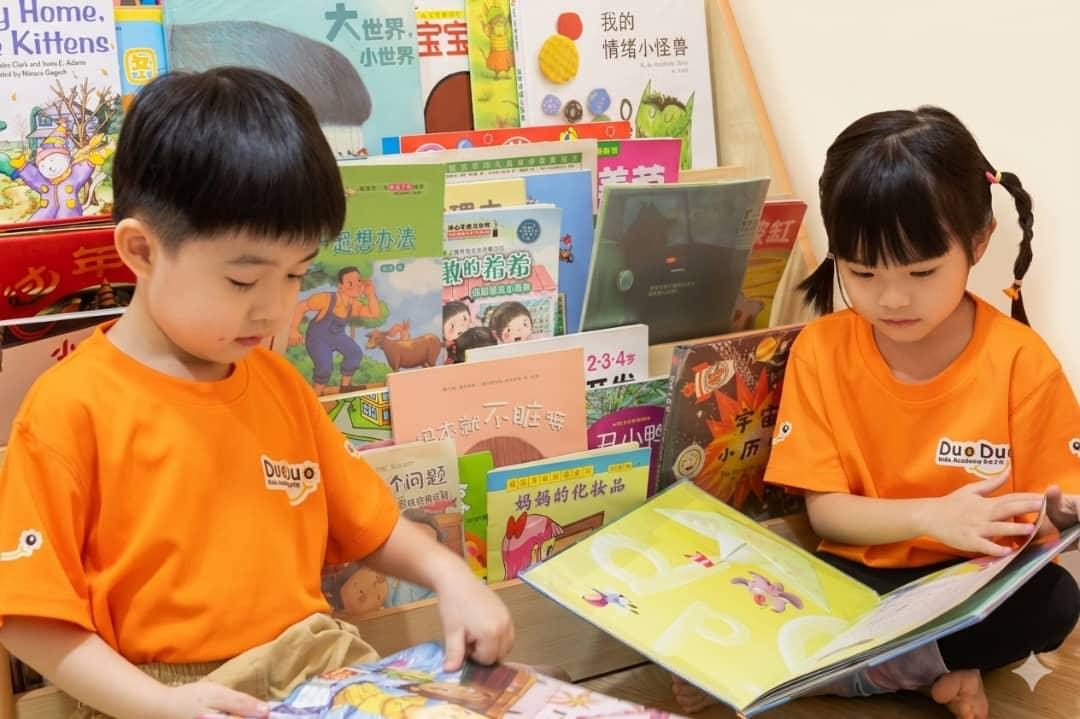
Why ten minutes is the right target
Ten minutes is short enough that a tired child on a school night will not refuse it, and long enough to read a picture book or a chapter of an early reader. Habits form through repetition, so a target you hit six days a week beats a target you hit twice.
For word recognition, daily reading is where the staircase pays off. Every word learned on cards is met again in a story, which is exactly the spaced, in-context review that makes recognition permanent.
Fix the time and the place
Attach reading to something that already happens every day. For most dual-income families in Malaysia, the best slot is right after the shower and before dinner, or the last ten minutes before lights out. Choose one and keep it for a month before changing anything.
Keep the books in that place, not on a shelf in another room. A basket beside the bed or the dining table removes the “go and find a book” step, which is where most habits die.
Choose books the child can actually read
The book must be at a level where the child recognises about 19 of every 20 words. Anything harder becomes a decoding exercise and the child will avoid it. Anything easier is fine; rereading favourites is how recognition becomes automatic.
- Age 4 to 5 (150 to 500 words): picture books with one line per page and repeated phrases.
- Age 6 (about 1,000 words): bridging books with 3 to 5 lines per page and pictures on every page.
- Age 7 to 8 (1,500 to 3,000 words): short chapter books, children's magazines, simple non-fiction about animals or space.
- Any age: comics with speech bubbles, which children read willingly and which use everyday words.
Sit with them for the first month
For the first four weeks, the parent sits beside the child, not with a phone. Take turns reading pages, or let the child read and you ask a question at the end of each page. Your presence is what makes the ten minutes feel like time together rather than a task.
After a month, the child can read alone while you sit nearby doing something quiet. Keep asking one question at the end: “What was the best part?” That single question keeps reading connected to meaning.
Track it and protect it
Children love a visible chain. A calendar on the fridge with one sticker per day of reading is enough. Aim for the chain, not for perfection; a missed day is fine as long as the next day resumes.
Protect the slot from homework overflow. If homework is not done, the ten minutes of reading still happens, and the parent tells the teacher why. DuoDuo Kidz Academy takes the same view in its Educare After-School Programme: teachers guide homework and understanding, but daily reading and the 1-to-1 lesson are never dropped for the sake of completing worksheets.
Where to start if reading has never been a habit
Start with comics or picture books below the child's level, so the first week is easy, and add one harder book each week. If you are unsure of the child's level, a word-recognition check settles it. DuoDuo Kidz Academy offers a free 60-minute 1-to-1 lesson with no payment, and the teacher will tell you which level of book to start with. WhatsApp 011-2828 8676.
FAQ
My child only wants to read English books. Is that a problem?
Keep the English reading and add ten minutes of Chinese at an easier level. Children avoid Chinese books because they are harder, so drop the level until the Chinese books feel as easy as the English ones.
Is listening to Chinese audiobooks the same as reading?
It builds vocabulary and listening but does not build word recognition. Use audio as a supplement, ideally with the book open so the child follows the text.
Give your child the most precious gift: the ability to learn on their own.
Book a free 60-minute 1-to-1 trial class in a single language subject. You'll see your child's true starting point — and exactly how we'll move forward. No payment, no obligation.