Last updated: · 6 min read
Chinese Tuition for SK Children Learning Mandarin as a Third Language
For a child in an SK (sekolah kebangsaan) school, Mandarin is usually a third language after Bahasa Malaysia and English, so Chinese tuition should begin with word recognition (认字), not with grammar or textbook chapters. DuoDuo Kidz Academy teaches Chinese 1-to-1 at the child's actual level using its staircase word-recognition system, following the path 认字 → 词语 → 造句 → 阅读理解 → 段落 → 作文, for ages 4 to 12.
Why SK children need a different Chinese path
A child in an SJK(C) school is surrounded by Chinese characters six hours a day. A child in an SK school might see Mandarin for a few periods a week, often in a mixed-ability class, and at home the language may be spoken but rarely read.
That means the SK child is not behind in Chinese; the child is simply starting later and with less exposure. Tuition that treats him like an SJK(C) pupil, opening a textbook chapter and asking him to read, produces frustration. Tuition that starts from the number of characters he actually recognises produces progress.
Word recognition first, always
Reading Chinese is impossible without recognising characters, and there is no shortcut through pinyin alone. DuoDuo Kidz Academy's staircase word-recognition system (阶梯式认字系统) adds characters in an order where each new one connects to those already known, so the child never faces a wall of strangers.
Targets give parents a sense of scale. DuoDuo's age-based goals are about 150 characters at age 4, 500 at age 5, 1,000 at age 6, 1,500 at age 7 and 2,000 to 3,000 at age 8. An SK child may start later on this staircase, but the staircase itself is the same; the teacher simply meets the child where he is.
Why 1-to-1 matters more for a third language
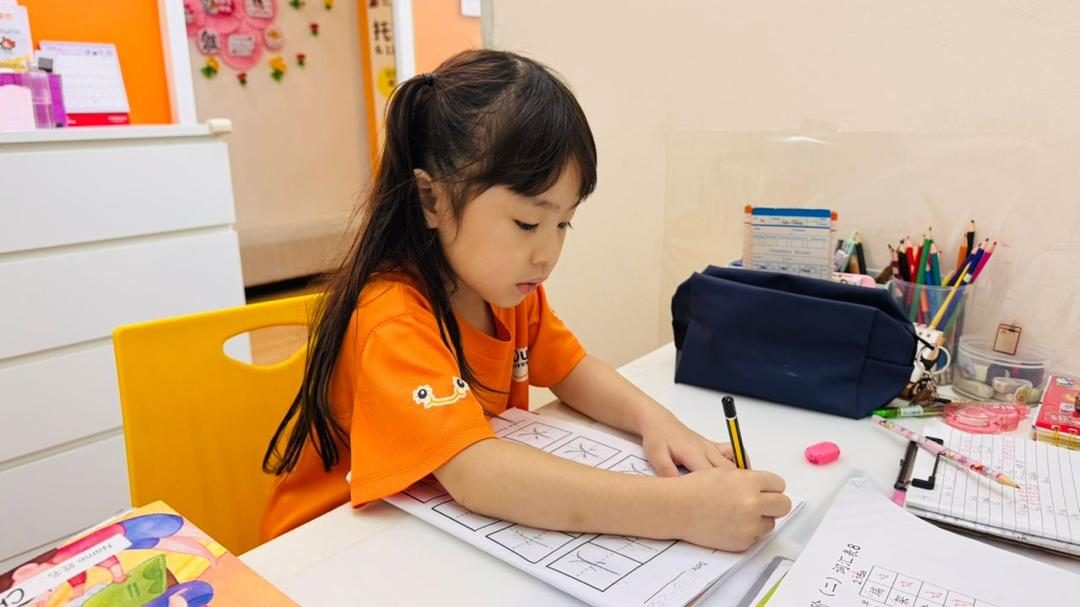
In a group Mandarin class, the SK child who knows 200 characters sits beside one who knows 800, and the lesson suits neither. One teacher to one child means the pace, the words and the questions are chosen for that child alone.
DuoDuo teachers guide with questions and never give the answer directly. When a child meets 妈 and hesitates, the teacher asks what the left part means and which sound the right part makes, and the child arrives at the reading himself. That moment is what builds confidence, and confidence is what keeps an SK child from giving up on Chinese.
From characters to sentences and beyond
The full DuoDuo Chinese path is 认字 (word recognition) → 词语 (vocabulary) → 造句 (sentence building) → 阅读理解 (comprehension) → 段落 (paragraphs) → 作文 (composition). There is no standalone composition class, because an essay written before the foundation is in place is copied, not composed.
Each child has a personal progress chart (个人专属进度表), and word-recognition tests are done live in front of parents, so an SK parent who does not read Chinese can still see exactly what the child can read.
- Stage 1: recognise and say characters connected to real things
- Stage 2: combine characters into two-character words
- Stage 3: build short sentences (造句) using known words
- Stage 4: read and answer short passages (阅读理解)
Start with a free trial
DuoDuo Kidz Academy has taught Chinese, Bahasa Malaysia and English 1-to-1 for 14 years across more than 10,000 families, with six branches in Kuala Lumpur, Taiping, Penang and Melaka.
The free trial is a 60-minute, single-language, 1-to-1 lesson, and Chinese is a natural choice for an SK child. WhatsApp 011-2828 8676 to book.
FAQ
My child speaks Mandarin but cannot read it. Where should tuition start?
With word recognition. Speaking helps, but reading requires recognising characters, so the first lessons establish how many characters the child knows and build upward from there.
Is Chinese tuition at DuoDuo suitable for a non-Chinese family?
Yes. Teaching is 1-to-1 at the child's level, and progress is shown live on a chart and in tests in front of parents, so parents who do not read Chinese can still follow.
Give your child the most precious gift: the ability to learn on their own.
Book a free 60-minute 1-to-1 trial class in a single language subject. You'll see your child's true starting point — and exactly how we'll move forward. No payment, no obligation.