
Last updated: · 3 min read
School Words in Bahasa Malaysia, English and Chinese: A Parent's Trilingual Glossary
Bilik darjah means classroom, murid means pupil, guru means teacher and kerja rumah means homework. Malaysian children hear school words in three languages every day, so this glossary groups 40 of the most common ones with their English and Chinese equivalents, in the order a Year 1 parent is most likely to meet them.
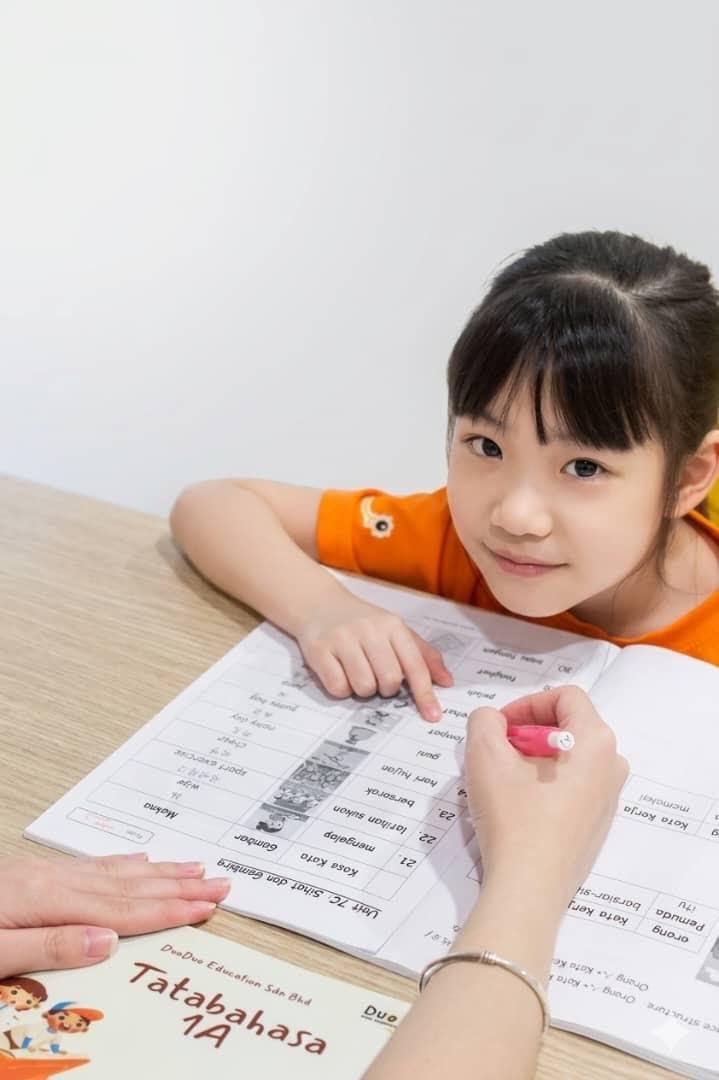
People and places at school
Start with the words your child will say first, because they appear in almost every conversation about school.
Who is who
Guru is teacher (老师), murid is pupil or student (学生), guru besar is headmaster or principal (校长), guru kelas is class teacher (班主任), pengawas is prefect (风纪) and rakan sekelas is classmate (同班同学). Pupils in Year 1 are murid Tahun 1 (一年级学生).
Where things happen
Bilik darjah is classroom (教室), kantin is canteen (食堂), perpustakaan is library (图书馆), padang is field (操场), dewan is hall (礼堂) and tandas is toilet (厕所). Knowing these helps a four- or five-year-old ask for what they need on the first day.
Things in the school bag and on the timetable
Objects and routines come next. Use real items at home to practise: pick up an eraser and say it in all three languages.
Objects, subjects and routines
Stationery and bag
Beg sekolah is school bag (书包), buku teks is textbook (课本), buku latihan is exercise book (练习簿), pensel is pencil (铅笔), pemadam is eraser (橡皮擦), pembaris is ruler (尺) and kotak pensel is pencil case (笔盒).
Quick tip: label things at home
Stick small labels on a pencil case and ruler in three languages.
Lessons and tests
Pelajaran is lesson (课), kerja rumah is homework (功课), ujian is test (测验), peperiksaan is examination (考试), keputusan is result (成绩), pentaksiran is assessment (评估) and kad laporan is report card (成绩单).
Quick tip: use them in sentences
Say "Time for kerja rumah" so the new word sits inside a real routine.
Time and calendar
Rehat is recess or break (休息), waktu persekolahan is school hours (上课时间), cuti sekolah is school holiday (学校假期), semester is term (学期) and Tahun 1 is Year 1 (一年级). Yuran is fees (学费) and PIBG is the parent-teacher association (家长教师协会).
Quick tip: post a weekly chart
Put a timetable on the fridge with all three languages.
Five ways to make the words stick
Memorising lists is dull. Try these habits instead.
- Name objects at home in all three languages during the daily routine, not as a quiz.
- Turn the school bag unpacking into a game: one item, three words.
- Use picture cards with one word per card and sort them into people, places, things.
- Read a story and point to the school words that appear.
- Ask your child to teach a sibling or grandparent one new word each day.
Why parents benefit as much as children
Many Malaysian parents grew up in a different school type from their children's, so the words on notices, WhatsApp groups and report cards can be unfamiliar. Learning the three-language versions helps you follow notices, join the conversation with teachers and help with homework instructions.
If your child attends SJK(C), notices may mix Chinese and Bahasa Malaysia; if SK, they may be in Bahasa Malaysia and English. A short glossary on the fridge solves most confusion.
How DuoDuo Kidz Academy can help
At DuoDuo Kidz Academy, children learn Chinese, Bahasa Malaysia and English side by side in 1-to-1 lessons, so school words move naturally between languages instead of being memorised three separate times. Teachers use real objects and pictures, and parents receive progress updates by WhatsApp. A free 60-minute trial in one language subject is the easiest way to see how this works for your child.
DuoDuo Kidz Academy offers three programmes for children aged 4–12: the 1-to-1 Trilingual Language Programme (Chinese, Bahasa Malaysia, English), the Educare After-School Programme (安亲班) and the Holistic Preschool Programme for ages 4–6. There are six branches — Danau Kota Setapak and Wangsa Maju (Kuala Lumpur), Taiping (Perak), Alma Bukit Mertajam and Bayan Lepas (Penang) and Semabok (Melaka) — with the same curriculum, teacher training and progress charts at every one.
FAQ
What does bilik darjah mean?
Bilik darjah is the Malay word for classroom, 教室 in Chinese.
What is guru besar in English?
Headmaster or principal, 校长 in Chinese.
What is PIBG?
Persatuan Ibu Bapa dan Guru, the parent-teacher association of a school.
What is the difference between SK and SJK(C)?
SK is a national school with Bahasa Malaysia as the main medium; SJK(C) is a national-type Chinese school where Chinese is the main medium of instruction.
Is the DuoDuo trial class really free?
Yes. The trial is one free 60-minute 1-to-1 lesson in a single language subject (Chinese, Bahasa Malaysia or English), with no payment and no obligation, so you can see your child's real starting point.
Which DuoDuo branch is nearest to me?
DuoDuo has six branches: Danau Kota Setapak and Wangsa Maju in Kuala Lumpur, Taiping in Perak, Alma (Bukit Mertajam) and Bayan Lepas in Penang, and Semabok in Melaka. WhatsApp 011-2828 8676 with your area and your child's age and we will point you to the closest one.
Give your child the most precious gift: the ability to learn on their own.
Book a free 60-minute 1-to-1 trial class in a single language subject. You'll see your child's true starting point — and exactly how we'll move forward. No payment, no obligation.