Last updated: · 3 min read
How to Praise Your Child So They Stay Motivated to Learn: Phrases That Work
The most helpful praise is specific, sincere and about effort, strategy or progress rather than ability. Say "You kept trying even when that character was hard" instead of "You are so smart", respond to mistakes with curiosity, and avoid comparing with other children. This builds the belief that skills grow with practice, which is what keeps children motivated.
Why the kind of praise matters
Children read our words as clues about what matters and what they are capable of.
Ability praise can backfire
Telling a child they are smart or talented can make them fear mistakes, because a mistake might prove them wrong. They may avoid hard tasks to protect the label.
Process praise builds resilience
When we notice effort, strategy and improvement, children learn that trying hard and changing approach lead to progress. They become more willing to take on challenges.
Praise that works
Aim for specific, honest and warm.
From generic to specific
Name what you saw
Describe the action: "You sounded out that whole word by yourself." This tells your child exactly what to repeat.
Quick tip: be specific
Replace "good job" with what they did.
Praise effort and strategy
"You kept going when it got tricky" or "Splitting the word into parts worked well." Focus on what your child controls.
Quick tip: notice the how
Mention the strategy used.
Respond to mistakes with curiosity
Say "That did not work yet. What could you try next?" Mistakes become information, not failure.
Quick tip: add the word yet
"Not yet" keeps the door open.
Ten ready-to-use phrases
Adapt them to your child.
- "I saw how hard you worked on that."
- "You remembered three new words today."
- "That mistake helped you learn something."
- "You are getting faster at this."
- "Tell me how you figured it out."
Things to avoid
Avoid comparing children, using praise to manipulate, or praising every small thing so much that it loses meaning. Children can tell when praise is not sincere.
Rewards can help for short-term habits, but aim to move gradually toward the pride your child feels in their own progress.
How DuoDuo Kidz Academy can help
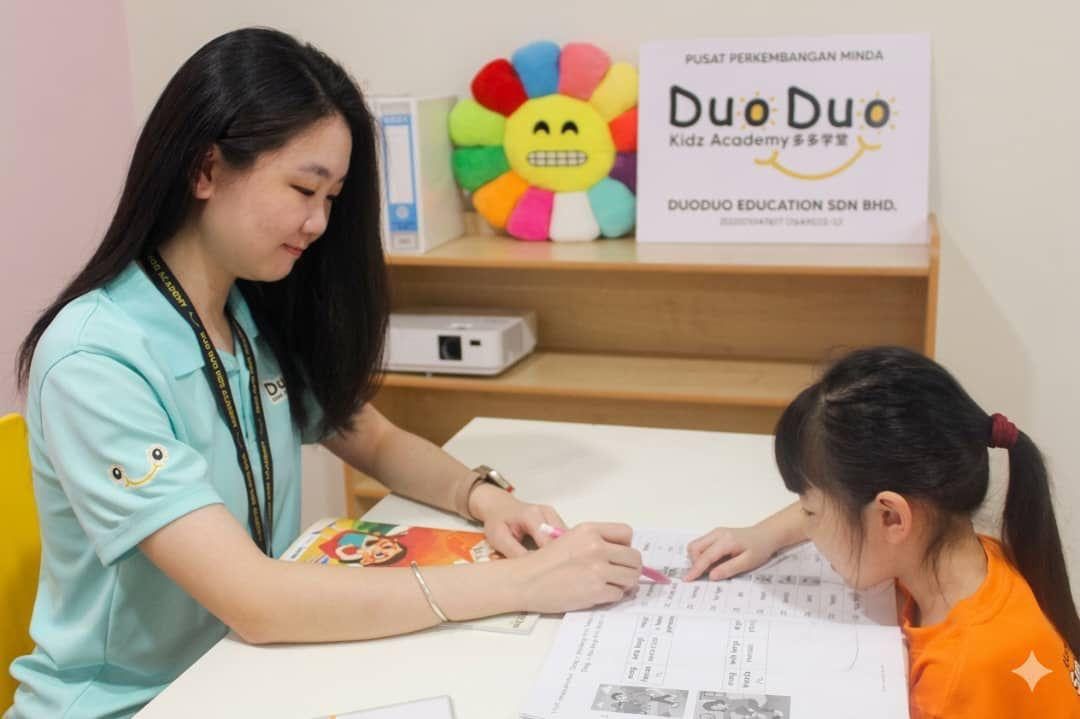
At DuoDuo Kidz Academy, teachers give specific feedback in 1-to-1 lessons and share a personal progress chart with parents, so you can echo the praise at home. Book a free 60-minute trial to see how we encourage children.
DuoDuo Kidz Academy offers three programmes for children aged 4–12: the 1-to-1 Trilingual Language Programme (Chinese, Bahasa Malaysia, English), the Educare After-School Programme (安亲班) and the Holistic Preschool Programme for ages 4–6. There are six branches — Danau Kota Setapak and Wangsa Maju (Kuala Lumpur), Taiping (Perak), Alma Bukit Mertajam and Bayan Lepas (Penang) and Semabok (Melaka) — with the same curriculum, teacher training and progress charts at every one.
FAQ
Is it wrong to say 'good job'?
Not wrong, but specific praise is more helpful because it tells the child what worked.
What should I say when my child fails?
Acknowledge feelings, then ask what they could try next.
Should I give rewards?
Small rewards for habits can help, but pair them with praise of effort.
How do I praise a shy child?
Praise privately and quietly if they dislike attention, focusing on the effort.
Is the DuoDuo trial class really free?
Yes. The trial is one free 60-minute 1-to-1 lesson in a single language subject (Chinese, Bahasa Malaysia or English), with no payment and no obligation, so you can see your child's real starting point.
Which DuoDuo branch is nearest to me?
DuoDuo has six branches: Danau Kota Setapak and Wangsa Maju in Kuala Lumpur, Taiping in Perak, Alma (Bukit Mertajam) and Bayan Lepas in Penang, and Semabok in Melaka. WhatsApp 011-2828 8676 with your area and your child's age and we will point you to the closest one.
Give your child the most precious gift: the ability to learn on their own.
Book a free 60-minute 1-to-1 trial class in a single language subject. You'll see your child's true starting point — and exactly how we'll move forward. No payment, no obligation.