Last updated: · 6 min read
Child Reads Fluently But Does Not Understand: What Is Missing?
A child who reads aloud fluently but cannot answer questions is usually missing one of three links: the meaning of individual words (词语), the habit of stopping to ask what a sentence means, or the confidence to answer in their own words. Reading aloud only proves decoding. DuoDuo Kidz Academy fixes this by teaching 词语 before 阅读理解 and by having teachers ask questions instead of giving answers, so the child learns to think while reading rather than just sound out words.
Fluent reading is decoding, not understanding
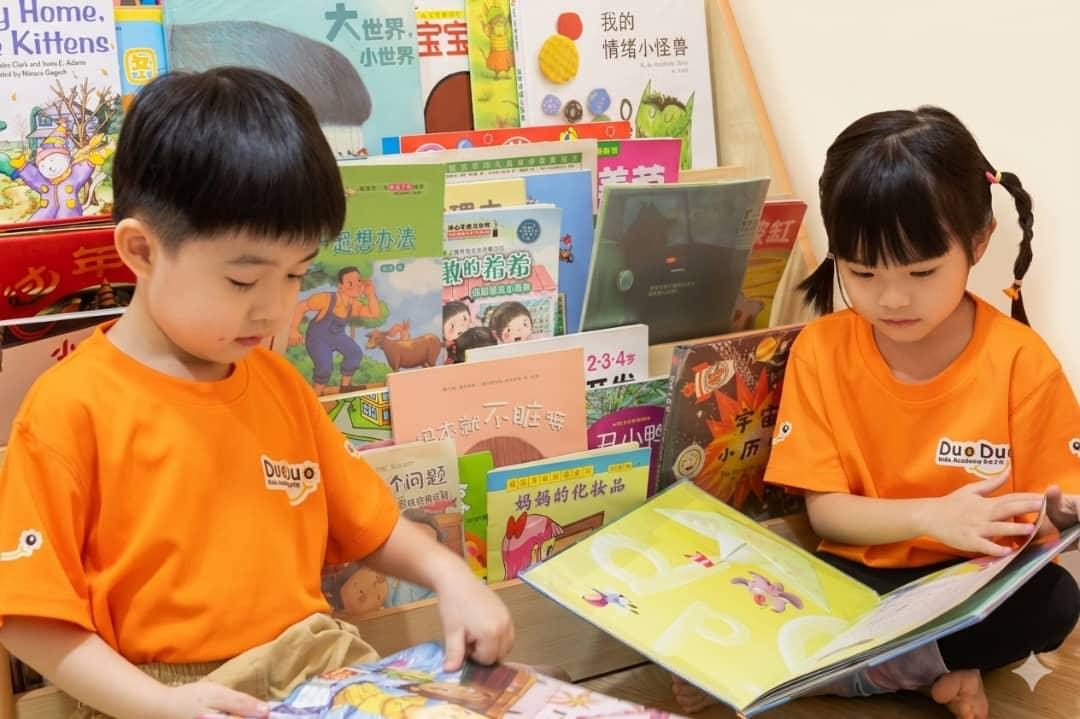
Reading a passage aloud without stumbling proves that the child can turn symbols into sounds. It says nothing about whether the sounds carried meaning. Many SJK(C) children in Primary 2 and 3 can read a 阅读理解 passage perfectly and then stare at question one.
This is more common in Chinese than in other languages because a child can recognise a character, pronounce it, and still not know the two-character word it belongs to. 明白 is not 明 plus 白. If the child has learned characters but not 词语, the passage is a string of sounds.
The three missing links, and how to spot which one
Each link fails in a recognisable way. A teacher can usually tell within one lesson which link is weak by asking the child to explain a sentence they have just read.
DuoDuo Kidz Academy checks this at the free trial. The teacher reads with the child, stops after a sentence, and asks a question about it. The type of answer the child gives points to the missing link.
- Vocabulary link: the child reads the word but cannot say what it means on its own
- Attention link: the child understands each sentence but cannot say what the paragraph was about
- Expression link: the child understands but answers by copying a line from the passage
Why the Chinese learning path puts 词语 before 阅读理解
The order matters. DuoDuo's Chinese path runs 认字 → 词语 → 造句 → 阅读理解 → 段落 → 作文. Comprehension sits in the middle because it depends on the three steps before it. A child who is pushed into 阅读理解 practice papers without a secure 词语 bank learns to guess from the question, not to read.
The same logic applies in Bahasa Malaysia, where perbendaharaan kata comes before membaca dan menulis, and in English, where vocabulary comes before reading. Skipping the vocabulary step is the single most common reason a fluent reader cannot answer questions.
Questions, not answers, build understanding
The fastest way to make a child think while reading is to ask them something after every few lines. DuoDuo teachers guide with questions and never give answers directly. “Who did that?” “Why do you think she was sad?” “What word tells you it was morning?” After a few weeks the child starts asking those questions silently on their own.
This is only possible one teacher to one child. In a class of twenty, the fluent reader is left alone because they sound fine. In a 1-to-1 lesson, the teacher hears the gap in the first minute.
What progress looks like
Within a term, most children move from copying a line to answering in their own words, and from “I don't know” to a guess that is roughly right. Their personal progress chart (个人专属进度表) records which 词语 are secure and which comprehension question types they can handle, so parents see the change rather than being told about it.
If your child reads well but scores poorly in 阅读理解, WhatsApp DuoDuo Kidz Academy at 011-2828 8676 for a free 60-minute 1-to-1 trial. We will show you which link is missing and start rebuilding it in the same lesson.
FAQ
My child understands stories when I read to them but not when they read alone. Why?
When you read, your voice carries the meaning and the child only has to listen. When they read alone, they are spending all their effort decoding. Once word recognition becomes automatic, that effort is freed up for meaning.
Will more 阅读理解 practice papers fix this?
Not on their own. Practice papers test comprehension; they do not build the vocabulary that comprehension depends on. Build 词语 first, then the papers start making sense.
Give your child the most precious gift: the ability to learn on their own.
Book a free 60-minute 1-to-1 trial class in a single language subject. You'll see your child's true starting point — and exactly how we'll move forward. No payment, no obligation.