
Last updated: · 6 min read
Bahasa Malaysia Guide for Chinese-School Parents: Why BM Is Hard and What Works
Bahasa Malaysia is hard for many SJK(C) children because it is often their third language, learned mostly in the classroom with little exposure at home. The fix is not more memorising but a fixed sequence: suku kata (syllables), then ejaan (spelling), then perbendaharaan kata (vocabulary), then membina ayat (sentence building), then reading and writing. DuoDuo Kidz Academy teaches BM 1-to-1 in exactly this order, at the child's actual level rather than the syllabus level.
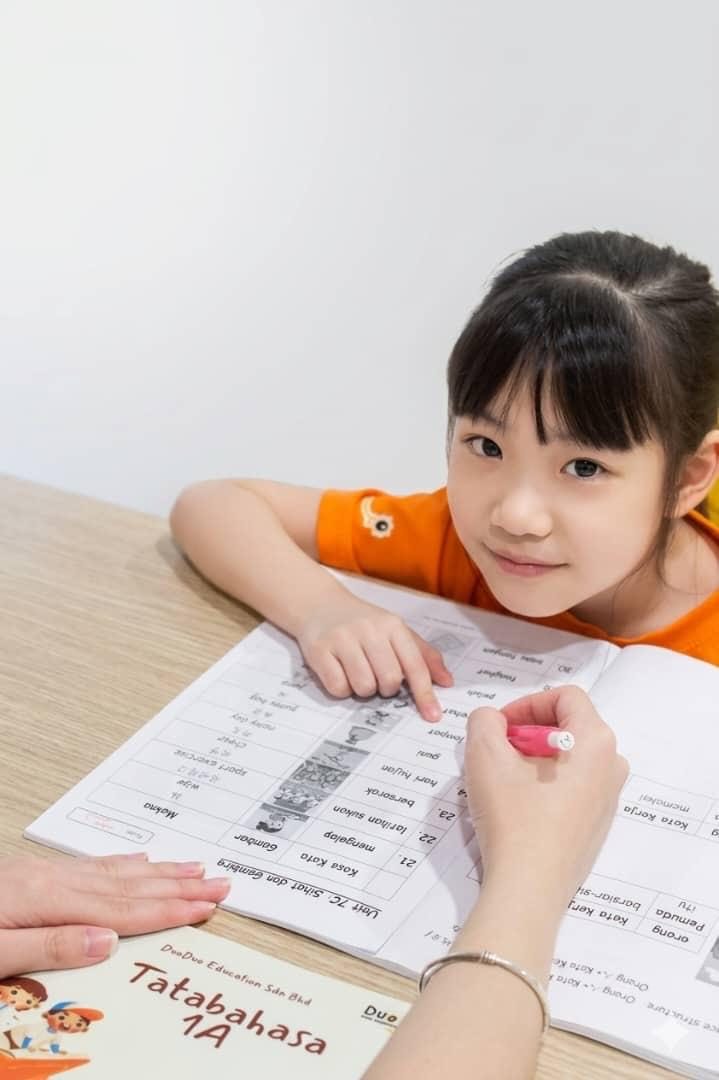
Why BM feels so hard for Chinese-school children
For most SJK(C) pupils, Bahasa Malaysia is a third language. Mandarin is spoken at home, English appears in cartoons, apps and family conversation, and BM often exists only inside the BM period at school. A child who hears a language for a few hours a week cannot absorb it the way a Malay-speaking child does.
The KSSR syllabus also moves fast. By Primary 1 (一年级), children are expected to read short passages, spell words in weekly Ejaan tests and write simple sentences. If the child has not learned how BM syllables work, every new word looks like a random string of letters that must be memorised.
The result is a familiar pattern: the child scores well on Ejaan for a week, forgets the words by the next week, and slowly decides that BM is “the subject I am bad at”. Confidence drops before skills do.
The mistake most families make: memorising instead of decoding
Memorising word lists feels productive but does not build reading ability. A child who memorises 10 Ejaan words has learned 10 words. A child who understands how “ba-tu” and “bu-ku” are built can read hundreds of words they have never seen before.
BM is a very regular language. Almost every word can be read by breaking it into syllables and sounding them out. This is a huge advantage compared with English, and it is the reason a structured approach works so quickly once a child is taught properly.
The sequence that works: from suku kata to writing
At DuoDuo Kidz Academy, BM is taught in a fixed staircase, and no step is skipped. Each child has a personal progress chart so the teacher and parent both know exactly which step the child is on.
- Suku kata (syllables): recognise and blend open syllables like ba, bi, bu and closed syllables like bat, bin, buk.
- Ejaan (spelling): use syllable knowledge to spell words by sound, not by rote.
- Perbendaharaan kata (vocabulary): learn high-frequency words in meaningful groups and use them in speech.
- Ayat pendek / membina ayat (sentence building): join words into short, correct sentences with the right imbuhan.
- Membaca dan menulis (reading and writing): read short passages, answer pemahaman questions and write paragraphs.
What parents can do at home even if their own BM is weak
You do not need to speak fluent BM to help. Your job is exposure and encouragement, not teaching grammar. Ten minutes a day of the right activity does more than an hour of drilling the night before a test.
- Read one page of a simple BM storybook together and let your child sound out the syllables.
- Label a few items at home in BM (pintu, meja, kerusi) and say them aloud daily.
- Watch a short BM children's programme together and repeat two or three words afterwards.
- Praise the process (“you broke that word into syllables correctly”) rather than the score.
How DuoDuo Kidz Academy teaches BM 1-to-1
DuoDuo Kidz Academy has 14 years of teaching experience and has served more than 10,000 families across six branches in KL, Perak, Penang and Melaka. Every BM lesson is one teacher to one child, and teachers guide with questions rather than giving answers, so the child does the thinking and builds real confidence.
Teaching starts at the child's real level. A Primary 3 pupil who still cannot blend closed syllables will start there, not at the Primary 3 textbook. That is why progress becomes visible within weeks.
If your child struggles with BM, book a free 60-minute 1-to-1 trial lesson. WhatsApp 011-2828 8676 and we will assess where your child is on the BM staircase and show you the next step.
FAQ
My child is in Primary 2 and still cannot read BM. Is it too late?
No. Because BM spelling is regular, a child who learns suku kata properly can catch up quickly. Most children show clear improvement within a few months of structured 1-to-1 lessons.
Should I speak BM at home if my own BM is poor?
Short, simple phrases are fine and helpful. Focus on exposure through storybooks and children's programmes rather than teaching grammar yourself.
Does DuoDuo teach BM to preschoolers?
Yes. The 1-to-1 Trilingual Language Programme accepts children from age 4, so BM foundations can be built before Primary 1.
Give your child the most precious gift: the ability to learn on their own.
Book a free 60-minute 1-to-1 trial class in a single language subject. You'll see your child's true starting point — and exactly how we'll move forward. No payment, no obligation.