Last updated: · 7 min read
Tadika dalam Bahasa Inggeris: English-Medium, Bilingual or Trilingual?
Tadika dalam bahasa Inggeris is simply “kindergarten”, but most parents searching the phrase want to know whether to choose an English-medium, bilingual or trilingual tadika. English-medium builds strong English but can leave Chinese and Bahasa Malaysia behind; bilingual covers two; trilingual prepares a child for all three languages a Malaysian school uses. For a child heading to an SJK(C), a trilingual tadika such as DuoDuo Kidz Academy's preschool is usually the best fit.
Tadika dalam bahasa Inggeris: the translation and the real question
The English word for tadika is kindergarten, and in Malaysia “preschool” is used for the same thing. That part is easy.
The harder question behind the search is about language of teaching. Parents want to know whether their child should spend the tadika years mainly in English, in two languages or in three, and what each choice means when Primary 1 arrives.
English-medium, bilingual and trilingual kindergartens compared
Each model has real strengths. The right one depends on the school your child will attend and the languages spoken at home.
- English-medium: English all day; strong spoken English and early reading. Risk: Chinese and Bahasa Malaysia become weak just before Year 1, where one of them is the medium of instruction.
- Bilingual: usually English plus Chinese or English plus BM. Balanced for two languages, but the third often arrives late and feels foreign.
- Trilingual: Chinese, Bahasa Malaysia and English daily. Demands more of the teaching, but the child meets all three school languages before Year 1 rather than in it.
Why trilingual suits SJK(C)-bound children
In an SJK(C), Chinese is the medium of instruction, Bahasa Malaysia is a core subject and English is taught from Year 1. A child who comes from an English-only kindergarten meets a Chinese textbook with few characters in hand, and a child with no BM base meets suku kata and ejaan for the first time.
A trilingual tadika avoids both gaps. DuoDuo Kidz Academy targets about 1,000 recognised words by age 6, which is Primary 1 ready, while building BM from suku kata and English from letter sounds. Starting all three at 4 makes each feel normal rather than a new subject in January.
How English grows in a trilingual tadika
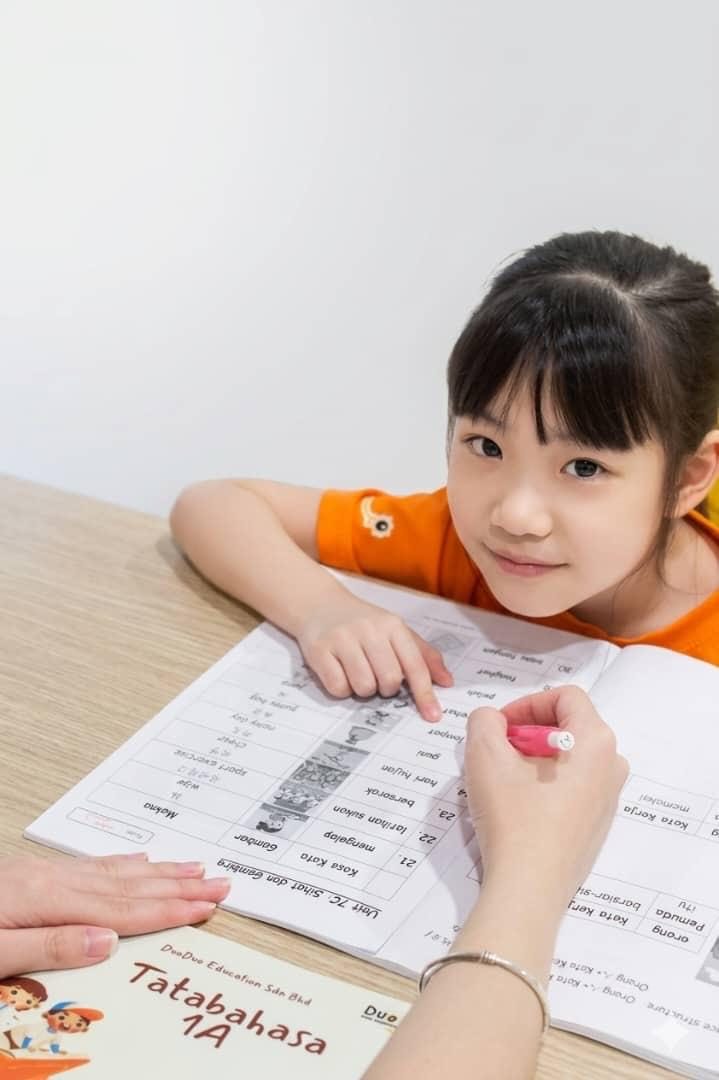
Choosing trilingual does not mean less English. At DuoDuo, English follows one clear path: letter sounds → phonics → vocabulary → reading. A child first learns what each letter says, then sounds out new words, then builds a vocabulary he can read and understand, and finally reads short passages.
Each child also has 1-to-1 language time at his own level, so a child who is ahead in English moves on while another who needs more time gets it. Want to know exactly how we balance three languages in one day? WhatsApp us and a teacher will answer you personally.
Visit DuoDuo preschool and hear all three languages
DuoDuo Kidz Academy's Holistic Preschool Programme (幼儿全方位成长课程) for ages 4 to 6 runs at six branches: KL Setapak Danau Kota, KL Wangsa Maju, Taiping, Alma (Bukit Mertajam), Bayan Lepas and Melaka Semabok, backed by 14 years of teaching experience and a 4.9/5 average parent rating.
WhatsApp 011-2828 8676 to book a free 60-minute, single-language, 1-to-1 trial lesson. Choose English, Chinese or Bahasa Malaysia and see how your child responds.
FAQ
What is tadika in English?
Tadika in English is kindergarten. In Malaysia “preschool” is also used for the same ages, 4 to 6.
Will a trilingual kindergarten make my child's English weaker?
Not if English is taught along a clear path. DuoDuo's English path is letter sounds → phonics → vocabulary → reading, with 1-to-1 time at the child's level.
My child will go to SK, not SJK(C). Is trilingual still useful?
Yes. BM and English matter most in an SK, and Chinese keeps a door open. A trilingual tadika simply lets you adjust the focus to your chosen school.
Give your child the most precious gift: the ability to learn on their own.
Book a free 60-minute 1-to-1 trial class in a single language subject. You'll see your child's true starting point — and exactly how we'll move forward. No payment, no obligation.