
Last updated: · 5 min read
My Child Speaks English but Cannot Read It: Why, and What to Do
A child can speak English fluently and still be unable to read it because speaking is learned by ear while reading requires a separate, taught skill: linking letters to sounds and blending them into words. Oral fluency actually makes the gap easy to miss, because the child guesses words from context and sounds confident. The solution is explicit phonics and daily decoding practice, which DuoDuo Kidz Academy teaches 1-to-1 as the first steps of its English path.
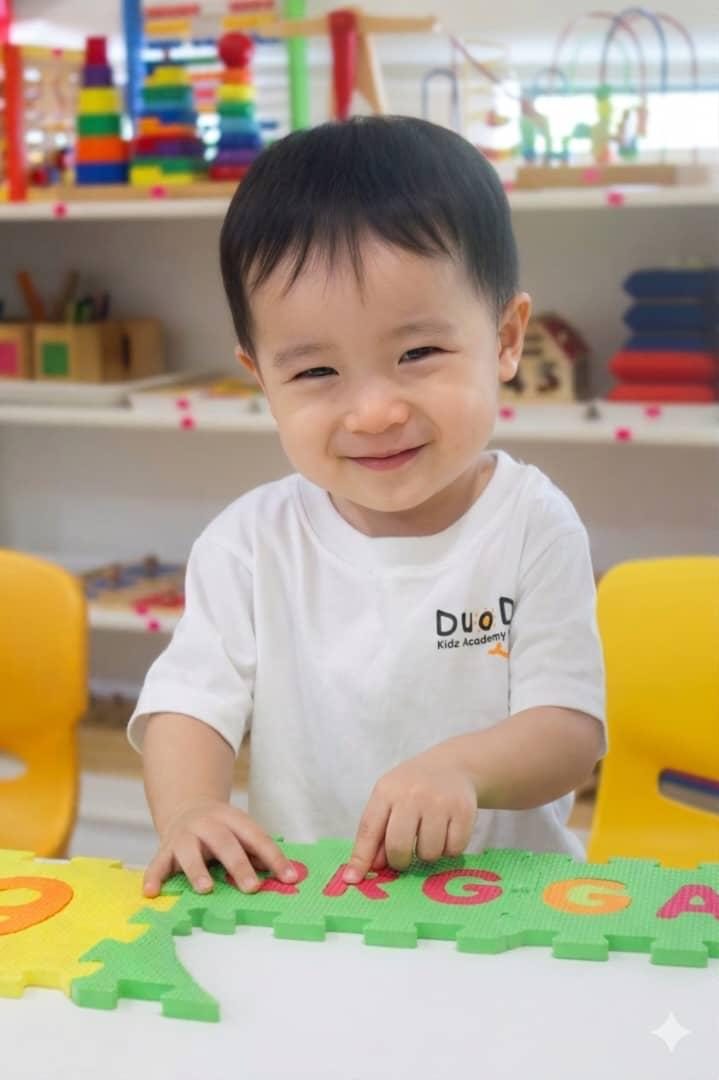
Why speaking and reading are different skills
Children learn to speak by listening and copying. Nobody teaches a toddler grammar, yet by four they can chat. Reading is different: the human brain is not wired to read naturally, and every child has to be taught how printed letters map to the sounds they already know.
This is why a child who watches English cartoons, talks with cousins in English and sounds fluent may still be unable to read “ship” or “jump”. The words are in their mouth but not yet connected to the page.
Why the gap is easy to miss
Fluent speakers are good guessers. Given a picture book, a child who speaks well will look at the picture, hear the first sound and produce a sensible word. It sounds like reading, and adults praise it, so the guessing habit strengthens.
The gap usually becomes obvious in Primary 1 or 2, when SJK(C) and SK textbooks move to pages with fewer pictures and more text. Suddenly the “good reader” cannot read, and both parent and child are confused.
How to check in five minutes at home
You can test decoding without any special material. Write these words on paper, with no pictures, and ask your child to read them aloud.
- Simple regular words: mat, pin, hop, bed, cup.
- Made-up words: zat, gim, pob. A decoder can read these; a guesser cannot.
- Longer regular words: sunset, picnic, rabbit.
- If your child refuses or guesses wildly on the made-up words, the decoding skill is missing.
What to do at home
The good news is that a fluent speaker learns to read fast once decoding is taught, because the vocabulary and sentence sense are already there. Keep sessions short and separate from bedtime story reading, which should stay relaxed and fun.
- Ten minutes a day of letter sounds and blending, using plain word cards rather than picture books.
- Cover the picture before reading a page so your child must use the letters.
- Sound-then-say: point to each letter, say its sound, then say the word.
- Praise attempts at sounding out, even wrong ones, more than correct guesses.
How DuoDuo Kidz Academy closes the gap
At DuoDuo Kidz Academy, the English path starts with letter sounds and phonics before vocabulary, reading. Because lessons are 1-to-1, the teacher can quickly tell whether a child is decoding or guessing and adjust the very next question.
Teachers guide with questions and never give the word away, which breaks the guessing habit within a few weeks. Parents can follow every step on the child's personal progress chart, the same system that has served more than 10,000 families over 14 years.
If your child talks confidently in English but cannot read simple words, WhatsApp 011-2828 8676 for a free 60-minute 1-to-1 English trial lesson. We will check decoding on the spot and show you the plan.
FAQ
Should I stop reading picture books to my child?
No. Keep reading to your child for enjoyment and vocabulary. Just add a separate short decoding session with plain words so the two skills develop together.
My child is 7 and has never done phonics. Is it too late?
Not at all. A 7-year-old with strong spoken English usually picks up blending very quickly once it is taught explicitly.
Give your child the most precious gift: the ability to learn on their own.
Book a free 60-minute 1-to-1 trial class in a single language subject. You'll see your child's true starting point — and exactly how we'll move forward. No payment, no obligation.